

Description
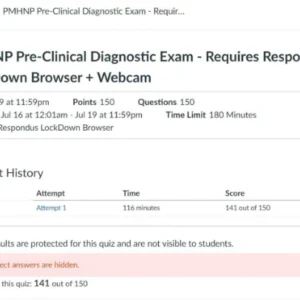
NR668 PMHNP Final Diagnostic Exam
[Oct 2026]

Question 1
Which personality disorder is most commonly associated with brief, stress-related paranoid ideation or severe dissociative symptoms?
- Borderline personality disorder ✅
- Paranoid personality disorder
- Schizoid personality disorder
- Schizotypal personality disorder
Question 2
A 35-year-old woman has a well-established history of recurrent major depressive disorder and opioid use disorder. During periods of opioid abstinence, she continues to experience major depressive episodes that meet full MDD criteria. Which diagnostic formulation is most appropriate?
- Opioid-induced depressive disorder
- Major depressive disorder caused by methadone
- Opioid use disorder with comorbid major depressive disorder ✅
- No depressive diagnosis can be made until opioid use disorder fully remits
Question 3
An 8 year old child is given 2 apples. 1 of the apples is cut into 3 pieces. The child recognizes that the chopped apple contains the same amount of apple as the intact apple. This is known as conservation. Which stage in Piaget’s theory of cognitive development does a child develop conservation?
- Concrete Operations ✅
- Formal Operations
- Sensorimotor
- Preoperational
Question 75
Which of the following highlights the core feature of Borderline Personality disorder?
- A pervasive pattern consisting of attention seeking and excessive emotionality
- A pattern of instability in interpersonal relationships, self image, affect and impulsivity ✅
- A pattern of social inhibition, critical response to negative evaluation and feelings of inadequacy
- A need for admiration, displays of grandiosity and a lack of empathy
Question 76
A 45-year-old patient with opioid use disorder has been maintained on buprenorphine-naloxone 8 mg/2 mg daily for six months. He attends appointments reliably, and a review of refill history and urine toxicology confirms good adherence with no return to illicit opioid use. Over the past two months he reports persistent, clinically significant cravings that intrude on daily functioning, most often triggered by high-risk situations, and he tolerates the current dose without sedation or other adverse effects. Which of the following is the most appropriate next step?
- Discontinue buprenorphine-naloxone and switch to methadone
- Confirm adherence and tolerability, then titrate the buprenorphine-naloxone dose upward toward the 16 mg/4 mg target ✅
- Add clonidine for craving management
- Switch to naltrexone
Question 148
Codeine is converted to morphine via CYP2D6 in the liver. This is an example of what?
- Positive allosteric modulator
- Prodrug ✅
- Negative allosteric modulator
- Paradoxical reaction
Question 149
Which of the following is an example of a protective factor that promotes resilience in children?
- A supportive caregiver relationship providing stability and emotional security ✅
- Consistent avoidance of challenging situations
- Emphasis on self-reliance without external assistance
- Frequent exposure to stressors to build tolerance
Question 150
A client with generalized anxiety disorder is asked to create coping cards as part of her CBT homework. What is the primary purpose of using coping cards in CBT?
- To document automatic thoughts
- To record daily fluctuations in thoughts and corresponding moods
- To provide immediate cognitive restructuring strategies ✅
- To identify anxiety provoking situations………………………………………..purchase all the 150 questions and answers at $99 only

















































































Customer Reviews
There are no reviews yet.